Bragg’s law gives the condition for X-rays to reflect strongly from a crystal: 2d sin θ = nλ, where d is the spacing between planes of atoms, θ is the glancing angle (measured from the plane, not from the normal), n is a whole number (the order) and λ is the wavelength of the X-rays.
It was worked out by William Henry Bragg and his son William Lawrence Bragg in 1913, and won them the 1915 Nobel Prize in Physics. Below I derive it step by step, then work through two examples and three practice questions with answers.
| Symbol | Meaning | SI unit |
|---|---|---|
| d | Distance between neighbouring planes of atoms | m (often given in nm or Å) |
| θ | Glancing angle between the X-ray and the atomic plane | degree or radian |
| n | Order of reflection: 1, 2, 3, … | none |
| λ | Wavelength of the X-rays | m |
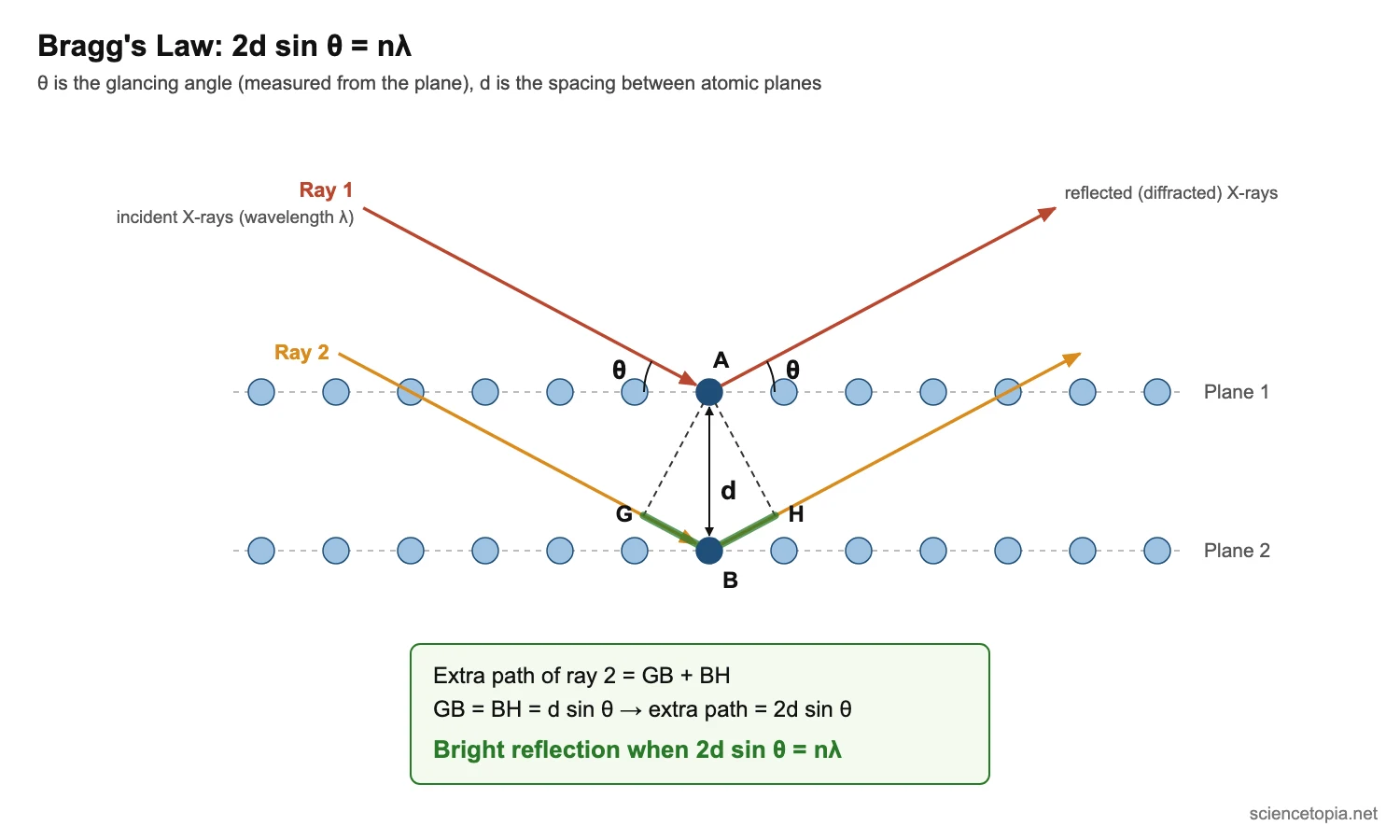
Statement of Bragg’s law
When X-rays fall on a crystal, every plane of atoms reflects a little of the beam, as if it were a weak mirror (angle of incidence equals angle of reflection). The waves reflected from different planes add up to a strong beam only when the extra distance travelled by the deeper ray is a whole number of wavelengths. That happens when 2d sin θ = nλ.
Derivation of Bragg’s equation
Use the diagram above. Ray 1 reflects from atom A on plane 1. Ray 2, parallel to it, reflects from atom B directly below on plane 2, a distance d deeper.
- Draw AG perpendicular to incoming ray 2 and AH perpendicular to outgoing ray 2. Up to G the two incoming rays have travelled the same distance, and after H the two outgoing rays travel the same distance.
- So the extra path travelled by ray 2 is GB + BH.
- In right triangle AGB, AB = d and the angle at A between AB and AG equals θ. So GB = d sin θ.
- By the same reasoning in triangle AHB, BH = d sin θ.
- Extra path = GB + BH = 2d sin θ.
- The reflected waves meet in phase (constructive interference) when the extra path is a whole number of wavelengths: 2d sin θ = nλ.
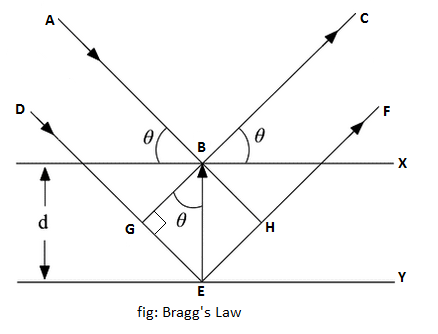
The same construction with different letters: here the extra path is GE + EH = 2d sin θ.
A note on the 2022 version of this page: it wrote the result as nλ = d sin θ, which drops the factor of 2. The correct law is 2d sin θ = nλ, and the worked example below has been recalculated with it.
Worked examples
1. Find the spacing between atomic planes
X-rays of wavelength 3.6 × 10⁻¹¹ m give a first-order reflection at a glancing angle of 4.8°. Find d.
2d sin θ = nλ, so d = nλ ÷ (2 sin θ) = (1 × 3.6 × 10−11) ÷ (2 × sin 4.8°) = 3.6 × 10⁻¹¹ ÷ (2 × 0.0837) = 2.15 × 10⁻¹⁰ m (0.215 nm).
2. Find the glancing angle
A rock-salt (NaCl) crystal has d = 0.282 nm. Copper X-rays of λ = 0.154 nm are used. Find the first- and second-order angles.
- n = 1: sin θ = λ ÷ 2d = 0.154 ÷ 0.564 = 0.273, so θ ≈ 15.8°.
- n = 2: sin θ = 2λ ÷ 2d = 0.546, so θ ≈ 33.1°.
Applications of Bragg’s law
- Finding crystal structure (X-ray diffraction, XRD): measuring the angles of strong reflections gives the spacings d, and from them the arrangement of atoms. This is how the structures of salt, diamond, proteins and DNA were found.
- Measuring X-ray wavelengths: with a crystal of known d, the angle gives λ (the Bragg X-ray spectrometer).
- Electron and neutron diffraction: moving electrons and neutrons behave as waves, so the same law applies to them.
Practice questions
1. X-rays of wavelength 0.1 nm fall on planes 0.2 nm apart. At what glancing angle is the first-order reflection?
2. Can visible light (λ = 500 nm) give Bragg reflections from a crystal with d = 0.3 nm?
3. The first-order reflection from a crystal is at 10°. At what angle is the second order?
Frequently asked questions
What is the formula of Bragg’s law?
Is θ in Bragg’s law the angle of incidence?
Why are X-rays used in Bragg diffraction?
What is the maximum order of reflection possible?
Related