Michelson’s rotating mirror method measures the speed of light by timing a light beam’s round trip over a long, known distance with a fast-spinning octagonal mirror. If the mirror has 8 faces and spins at f revolutions per second, and the distant mirror is d away, then c = 16 f d (in general, c = 2 m f d for an m-sided mirror).
In 1926 Albert Michelson used a distance of about 35 km between Mount Wilson and Mount San Antonio in California and obtained about 299,796 km/s, very close to today’s value. Below I describe the set-up, derive the formula, work through the numbers and finish with practice questions.
Apparatus and working
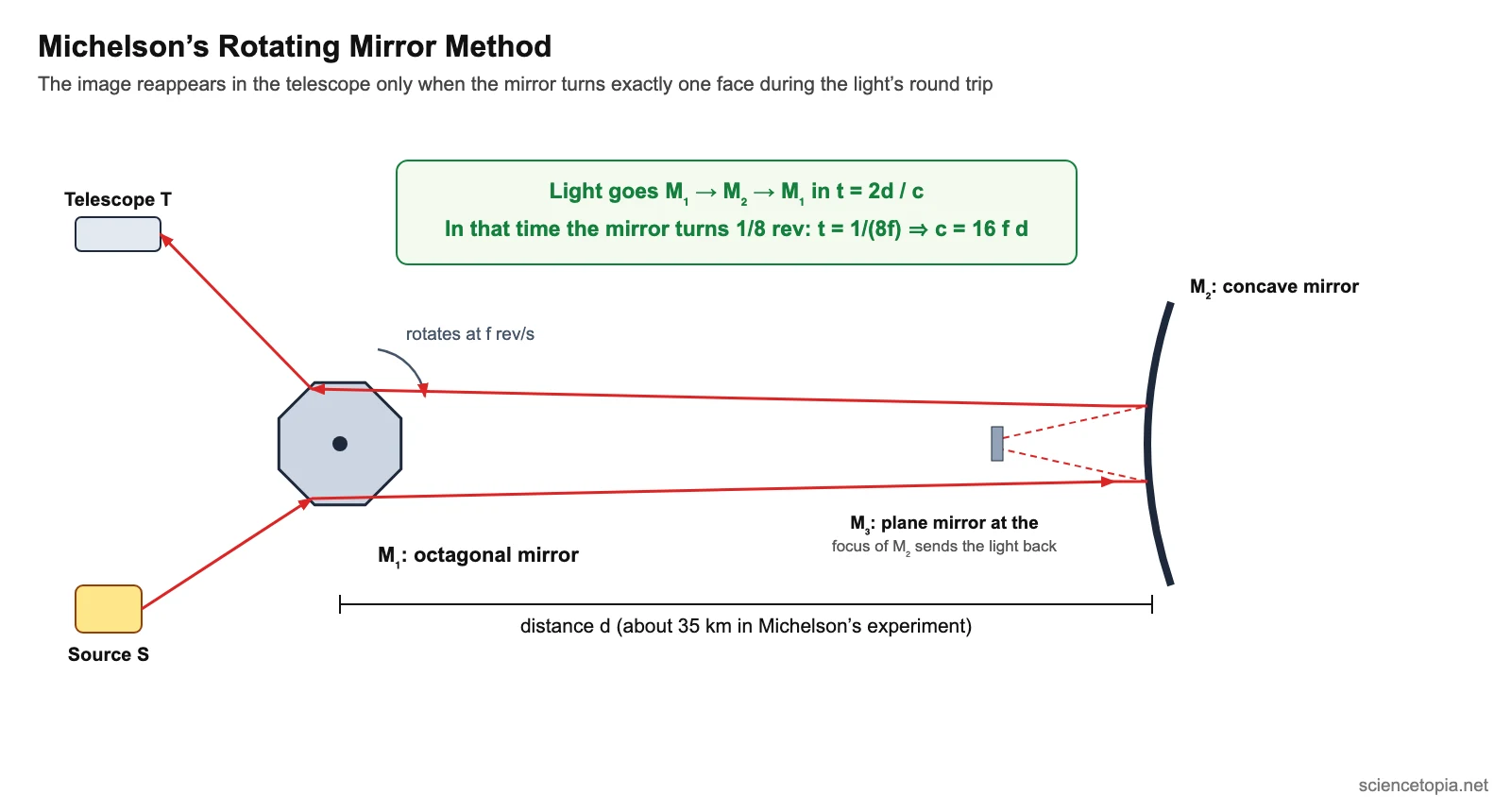
- Light from a bright source S passes through a slit and falls at 45° on one face of an octagonal mirror M1, mounted on a motor whose speed can be varied.
- The reflected beam travels to a distant concave mirror M2. A small plane mirror M3 at the focus of M2 sends the beam back to M2 and then back to M1.
- With M1 at rest, the returning light reflects off another face into a telescope T, and you see an image of the slit.
- When M1 spins, the returning light usually meets a face at the wrong angle and the image disappears.
- Increase the speed until the image reappears steadily. At that speed the mirror turns exactly 1/8 of a revolution (one face) during the light’s round trip.
Derivation of c = 16 f d
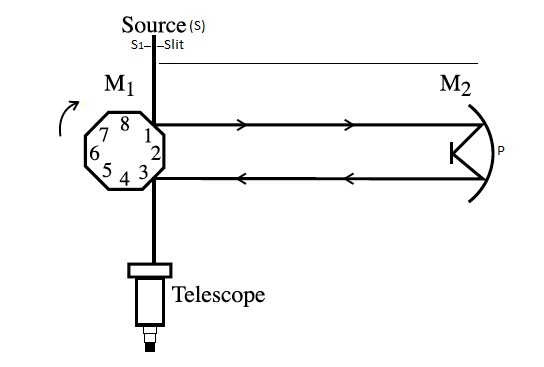
- Time for light to travel from M1 to M2 and back: t = 2d ÷ c.
- Time for the mirror to turn one face (1/8 of a revolution) at f revolutions per second: t = 1 ÷ (8f).
- When the image reappears, these times are equal: 2d ÷ c = 1 ÷ (8f).
- So c = 16 f d. For a mirror with m faces, c = 2 m f d.
Worked example
Take d = 35.4 km = 3.54 × 10⁴ m and an octagonal mirror spinning at f = 528 rev/s. Then c = 16 × 528 × 3.54 × 104 ≈ 2.99 × 10⁸ m/s.
Since 1983 the speed of light in a vacuum has been fixed by definition at exactly 299,792,458 m/s; the metre is now defined from it.
Advantages and limitations
| Advantages | Limitations |
|---|---|
| The distance is very large, so the time is long enough to measure accurately | It is hard to keep a high rotation speed perfectly steady for a long time |
| It is a null method: you only judge when the image reappears, not how far it has moved | At very high speeds the mirror can distort or break (using more faces lowers the speed needed) |
| The returning image is bright and easy to locate | The light travels through air, so a small correction is needed for the speed in a vacuum |
Practice questions
1. An octagonal mirror gives a steady image when spinning at 500 rev/s, with the distant mirror 37.5 km away. Find c.
2. If a 12-sided mirror were used over the same distance, would it need to spin faster or slower?
3. Why must the distance d be large?
Frequently asked questions
What is the formula in Michelson’s method?
What value did Michelson get for the speed of light?
Why is an octagonal mirror used?
What is the exact speed of light?
Related