The dimensional formula of linear momentum is [M1 L1 T−1] and the dimensional formula of angular momentum is [M1 L2 T−1]. Their SI units are kg m s−1 and kg m2 s−1.
Angular momentum has one extra power of length because it is linear momentum multiplied by a distance. Below I derive both, show you the quantities they’re often confused with, and give you three practice questions with answers.
| Linear momentum | Angular momentum | |
|---|---|---|
| Symbol | p | L |
| Formula | p = m v | L = r × p = I ω |
| Dimensional formula | [M1 L1 T−1] | [M1 L2 T−1] |
| SI unit | kg m s−1 (= N s) | kg m2 s−1 (= J s) |
| Scalar or vector | Vector | Vector |
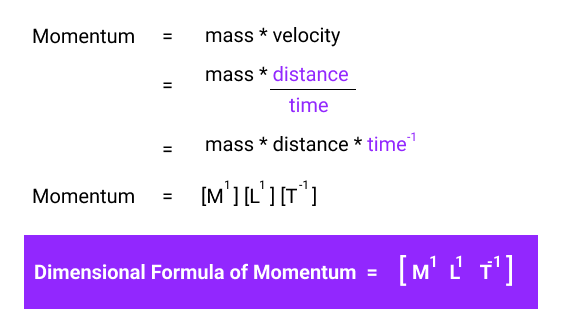
How to derive the dimensional formula of linear momentum
- Step 1. Momentum = mass × velocity, p = m v.
- Step 2. Velocity is displacement ÷ time, so it is [M0 L1 T−1]. See the dimensional formula of velocity.
- Step 3. Multiply by mass [M]: p = [M] × [L T−1] = [M1 L1 T−1].
How to derive the dimensional formula of angular momentum
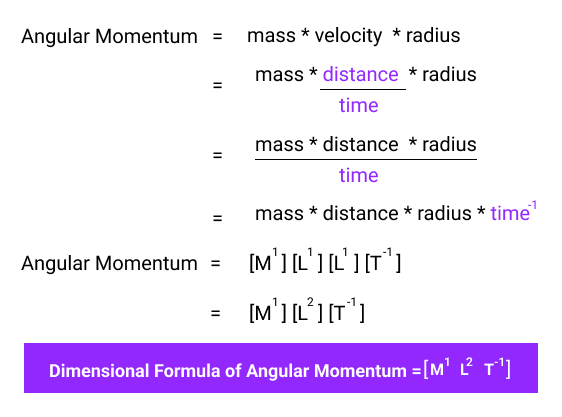
Angular momentum about a point is the moment of linear momentum: L = r × p, where r is the distance from the point.
- Step 1. L = r × p.
- Step 2. r is a length [L], and p is [M1 L1 T−1].
- Step 3. Multiply: L = [L] × [M1 L1 T−1] = [M1 L2 T−1].
You get the same result from L = I ω. Moment of inertia I is [M L2] and angular velocity ω is [T−1], so I ω = [M1 L2 T−1]. Details: dimensional formula of moment of inertia.
Same dimensions, different quantities
| Quantity | Formula | Dimensional formula | Same as |
|---|---|---|---|
| Impulse | F × t | [M1 L1 T−1] | linear momentum |
| Planck’s constant | h = E ÷ ν | [M1 L2 T−1] | angular momentum |
| Angular impulse | τ × t | [M1 L2 T−1] | angular momentum |
| Force | dp ÷ dt | [M1 L1 T−2] | neither (momentum per second) |
| Torque | dL ÷ dt | [M1 L2 T−2] | neither (angular momentum per second) |
Planck’s constant having the same dimensions as angular momentum is why Bohr could write the electron’s angular momentum as n h ÷ 2π.
Worked example
A 0.15 kg cricket ball travels at 20 m/s. Its linear momentum is p = 0.15 × 20 = 3 kg m s−1.
A 0.5 kg stone on a 2 m string moves in a circle at 4 m/s. Its angular momentum about the centre is L = m v r = 0.5 × 4 × 2 = 4 kg m2 s−1. Units: kg × m s−1 × m = kg m2 s−1, as expected.
Practice questions
1. Show that p² ÷ 2m has the dimensions of energy.
2. Bohr’s model says L = n h ÷ 2π. Check that it is dimensionally consistent.
3. Torque is the rate of change of angular momentum. Use this to find the dimensional formula of torque.
Frequently asked questions
What is the dimensional formula of momentum?
What are the dimensions of angular momentum?
Do impulse and momentum have the same dimensional formula?
What is the SI unit of angular momentum?
Related